
Gaps overnight & on weekends
A freezer can drift for hours between manual checks. By the time someone writes it down, product is already lost.
Cold-chain & refrigeration
Continuous wireless temperature and humidity monitoring for restaurants, hotels, schools, grocery and cold storage - with HACCP-ready records an inspector can trust.
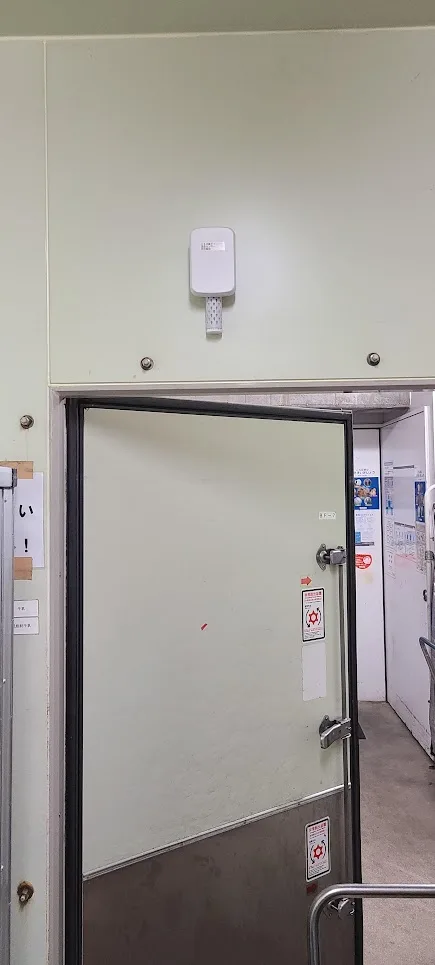
A freezer can drift for hours between manual checks. By the time someone writes it down, product is already lost.
Hand-written sheets get back-filled, smudged, or lost - and won't survive a serious audit or a recall investigation.
Without continuous data you can't prove what spoiled, when, or why - so the loss just becomes someone's bad week.
Magnet, Velcro, or adhesive - a battery-powered sensor inside each cooler, freezer or display case. No wiring, no drilling into the box.
One LoRaWAN™ gateway covers a whole building - even through thick freezer walls - and connects to the cloud.
Define safe ranges per unit. Pick who gets an SMS, email or call - or trigger a stack light on the floor - with no caps on rules or recipients.
Every reading is logged automatically. Export a clean, time-stamped PDF the moment an inspector asks.
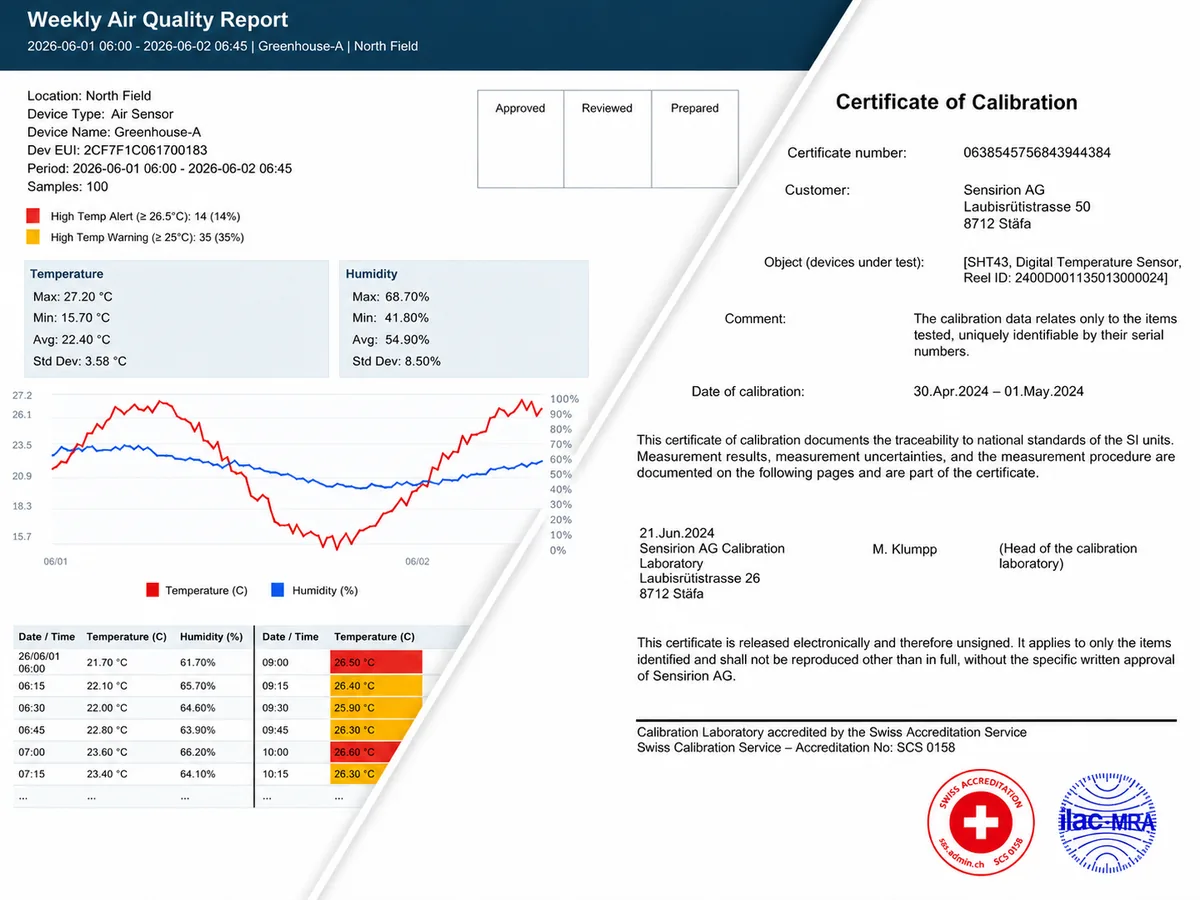
Continuous, tamper-evident logs with NIST-traceable accuracy - and dual-sensor verification so a drifting probe can never quietly corrupt your history.
Anyone can stick a thermometer in a freezer. CropWatch is engineered so the number you log is one you can defend - and so a failing sensor never quietly becomes a failed audit.
Every sensor is calibrated in an accredited process and ships with its own NIST-traceable certificate tied to its exact serial number. Not a batch sheet - proof for the specific device on your wall, downloadable the moment an inspector asks.
Two independent Sensirion sensors (SHT43 + SHT40) cross-check every reading. If they disagree, the device refuses to publish and raises an error code instead. You will never log an inaccurate number - "No Data" beats "Wrong Data" every single time.
On-site calibration eats hours and, without lab-grade reference equipment, introduces error. CropWatch skips it entirely: the sensing elements drift less than 0.02 °F (0.01 °C) a year, typical, and when a detector does reach end of life you snap in a pre-calibrated module in under a minute. No truck roll, no guesswork, no gap in your records.
A single Saft lithium thionyl chloride cell runs up to 10 years at the sensor's 10-minute reporting cadence. When it finally runs down, you swap it yourself - no returning the unit, no proprietary service call. The sensor stays exactly where it is and keeps right on logging.
Wi-Fi and Bluetooth die at the freezer wall. Our LoRa-based signal pushes through thick insulated panels and below-grade walk-ins, so a single gateway blankets the whole building - even the boxes others can't reach.
An unmatched track record for long-term sensor stability - annual temperature drift is typically under 0.02 °F (0.01 °C) - backed by people who actually pick up when you need them. The hardware self-audits and flags drift before it misleads you - and we're there when it counts.
Ordinary sensors give up the moment something glitches. CropWatch is built around EN 50271-compatible safeguard circuitry - the functional-safety discipline used in life-critical gas detection - backed by two independent watchdogs: a software monitor and a separate hardware circuit on the board. If the processor ever hangs or an internal fault hits, the device catches it, holds a safe state and restarts itself back into monitoring automatically - no manual reset, no service call, no gap in your record.
Organized data and reports are available via the web dashboard, and can be downloaded in CSV or PDF format for further analysis or record-keeping. This ensures that you have access to your data whenever you need it, without any restrictions.
While not strictly part of the services we provide, we have previously created custom reports to match existing workflows for customers. Reach out to us on the contact page if this is something you would like to discuss.
Yes. LoRaWAN™ punches through thick freezer walls far better than Wi-Fi or Bluetooth, and a single gateway typically covers an entire building. For very large or below-grade sites we add a second gateway.
That's what they're built for. Readings are logged automatically with NIST-traceable accuracy, dual-sensor verification, and per-serial ISO/IEC 17025 certificates. The primary SHT43 sensor's calibration is covered by the ILAC-MRA, so its certificate is recognized by accreditation bodies worldwide - not just in the country it was issued. You can export a clean, time-stamped report for any range in one click.
The dual-sensor design catches a drifting element and withholds the reading rather than logging a wrong one. You will see an error indication on the web dashboard and receive an alert email or SMS. Annual drift is typically under 0.02 °F (0.01 °C), so most modules never need replacing early - and when one does reach end of life, you swap it yourself in under a minute.
Readings keep landing in the sensor's onboard FRAM memory - a storage type rated for more than a trillion write cycles that holds data for decades without power. The device buffers up to 36 readings (about 6 hours at its 10-minute cadence) and re-sends them automatically when the connection returns, so your log has no holes.
No. Unlimited users, alert rules, recipients, reports and full API access are included with the sensors - no tiers, no seat licenses, no metered exports.
Our sensors prioritize long-term stability and NIST-traceable accuracy over short-term bragging rights. ±0.9 °F (±0.48 °C) reflects real-world performance, including typical drift, rather than idealized lab conditions. The #1 thing we do NOT want is for an auditor to check our numbers against another device and find a discrepancy. Our ±0.9 °F spec is defensible in an audit.
The toughest environment we have installed a sensor in is a walk-in flash freezer. Daily it drops from +21 °C (+70 °F) to around −37 °C (−35 °F) in a matter of minutes and stays at that temp for a few hours. Our sensor was selected for this after others broke within a few weeks.
Ready when you are
Tell us how many coolers and freezers you run. We'll size the sensors and gateway and show you the audit trail it produces.